Thinking, in progress.
Articles, short observations and video - noticed while working with people, products and the systems around them. Numbered honestly, from the beginning.
Filter by type
Filter by lens
2 items shown
If we're going to outsource more cognition to machines, which human capabilities are worth deliberately exercising?
Very short exercises. Analogue on purpose, usually done with a pen. Not a productivity system and not a defence of doing things the hard way.
- Ideation
- Observation
- Curiosity
- Synthesis
- Judgement
- Memory
- Storytelling
- Lateral thinking
More exercises will follow, at the pace they deserve.
- ArticleNote #002Experimental techAI · Product design
Stop hot-gluing AI onto things.
We embedded apps into products once because everyone wanted to own the experience. AI might be heading through the same awkward phase.
Back in 2011, when I was working almost entirely in mobile and apps, a lot of organisations went through a slightly wonky "mobile-first" phase.
They knew mobile mattered. They knew apps were becoming part of people's everyday journeys.
But instead of making those journeys seamless and centred around people's own devices, some tried to force their idea of "good app usage" into the product.
Sometimes quite literally.
I saw expensive hardware with cheap Android tablets embedded inside it, locked down with a branded interface. One was essentially a tablet hot-glued into a very expensive stereo.
The thinking seemed to be:
"People like using apps for music. So we'll put a device inside the product so they can use an app... but we get to own the experience."
We all know how that went.
Products like these were deeply unpopular and quietly disappeared.
The problem wasn't the app
People don't experience apps as isolated tools.
Their phone or tablet is a window into their own digital ecosystem:
- their accessibility settings
- their fonts, colours, sounds and preferences
- their workflows and habits
- their ability to move between contexts and applications
- their sense of control and ownership
The device wasn't simply a replacement for physical buttons. It was an extension of someone's personal digital environment.
When you ripped an app out of that ecosystem and imprisoned it inside a product, you removed much of what made it useful in the first place.
Which brings me to AI
I keep thinking about that era when I look at how we're designing AI into products today.
There's a risk we're doing exactly the same thing again.
We're hot-gluing AI onto things.
A chatbot here.
A branded AI panel there.
A bespoke assistant carefully imprisoned inside a company's existing experience.
It can look impressive now.
But it may also feel fragile and dated surprisingly quickly.
Because yes, people might want to use your AI.
But maybe what they'll increasingly want is to bring their AI into your product.
Just as mobile became less about individual branded apps and more about an interconnected personal ecosystem, AI may become something that moves with the person.
Something that knows their preferences, context and needs, and can interact with different products and services on their behalf.
That creates a different design question.
Not:
"Where should we put the AI feature?"
But:
"How should our product work when AI is part of the user's ecosystem rather than ours?"
That might mean designing services that personal AI can understand, access and interact with.
It might mean thinking less about owning every interaction and more about interoperability, permissions, trust, context and control.
And it might mean accepting that the most useful AI experience isn't always the one with your logo on it.
We've been here before
Technology changes quickly.
Human behaviour is usually a bit more stubborn.
When new technology arrives, organisations understandably want to own it, contain it and make it part of their brand experience.
But history suggests that tightly controlled, beautifully branded Franken-features tend to age badly.
Systems that respect how people actually use their technology tend to last longer.
So maybe don't hot-glue the AI into the stereo just yet.
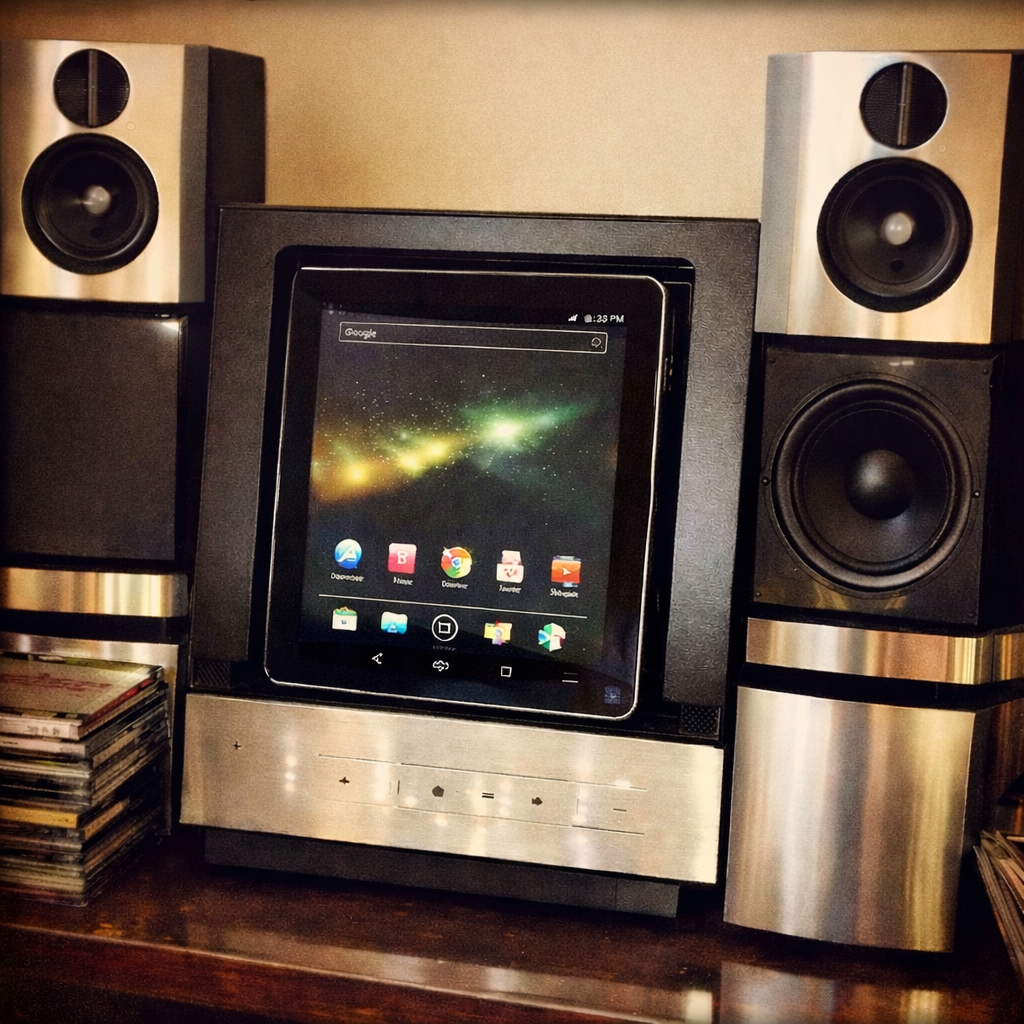
An AI-generated reconstruction, because naming and shaming a stereo manufacturer 15 years later seemed unnecessary. Sep 20265 min read - ArticleNote #001SystemsContent · Information architecture
Your content is a horse. Bear with me.
A needlessly equestrian explanation of structured content, information architecture and why reusable content still needs somewhere to live.
I was trying to explain structured content without saying "structured content", because that's usually the point at which perfectly sensible people start looking for an escape route.
So: ponies.
Traditional websites tend to organise content around pages.
You write some content for a page. Then someone needs the same thing somewhere else, so they copy it. Then one version changes. Another doesn't.
Soon there are three slightly different horses wandering around the internet and nobody knows which one is canonical.
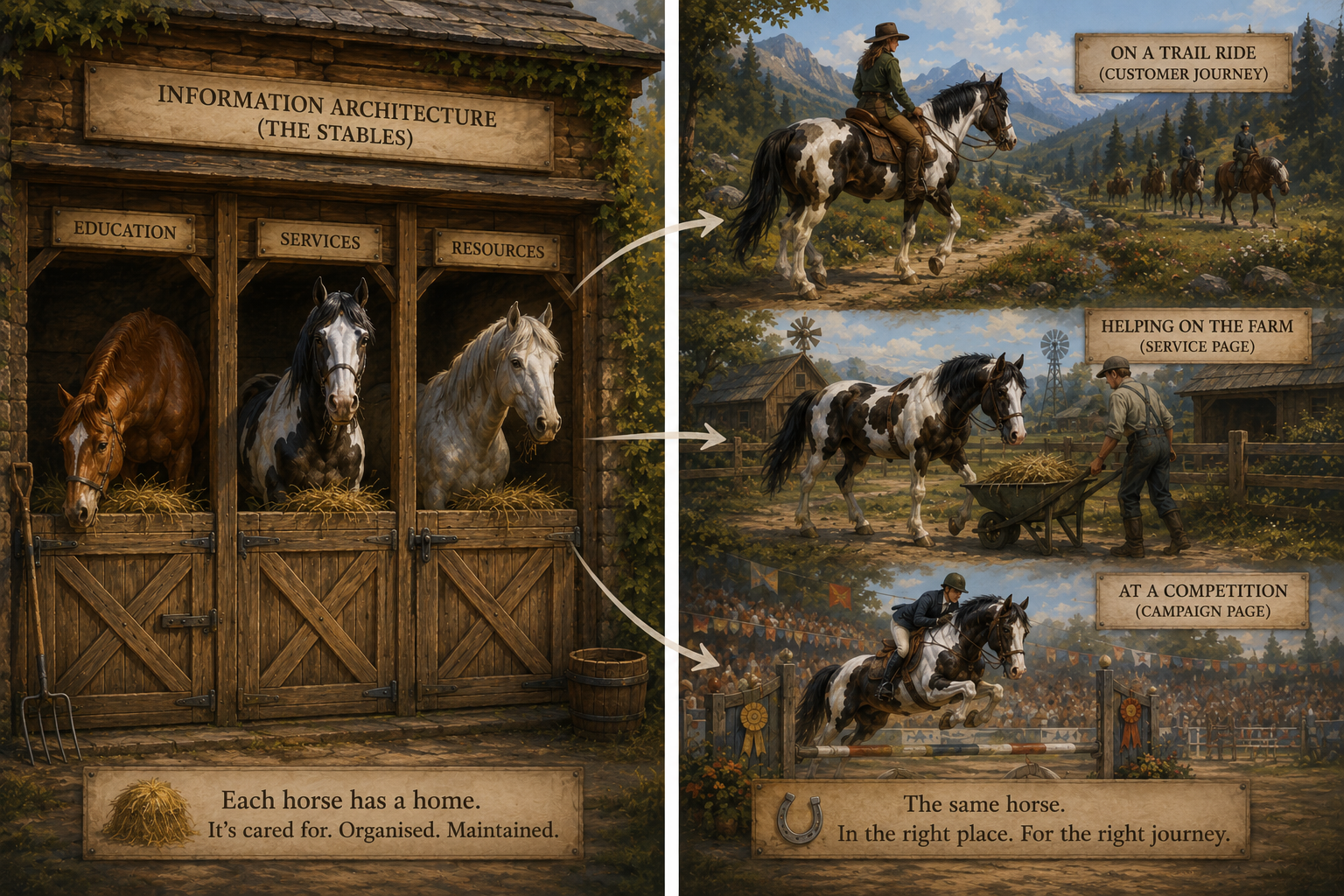
A better content model gives the horse a stable.
It has a home. We know what it is, what information belongs to it and how it's maintained.
But having a home doesn't mean it has to stay there.
The same horse can go on a trail ride, help on the farm or compete at a show.
And the same well-structured piece of content can appear in a customer journey, a service page, a campaign, an app, a search result or, increasingly, be retrieved and assembled by an AI interface.
Same horse. Right place. Right journey.
That's why information architecture isn't just deciding where pages go in a navigation.
Done properly, it's part of designing the underlying system that allows content to move, adapt and remain coherent as the experience changes around it.
And that's becoming more important, not less.
When the experience is no longer necessarily a predetermined collection of webpages, but might be dynamically assembled, personalised or conversational, the structure and meaning underneath the interface really matter.
The interface can change.
The horse still needs a stable.
Also, horses need good governance.
Nobody wants an ungoverned horse.
 Aug 20264 min read